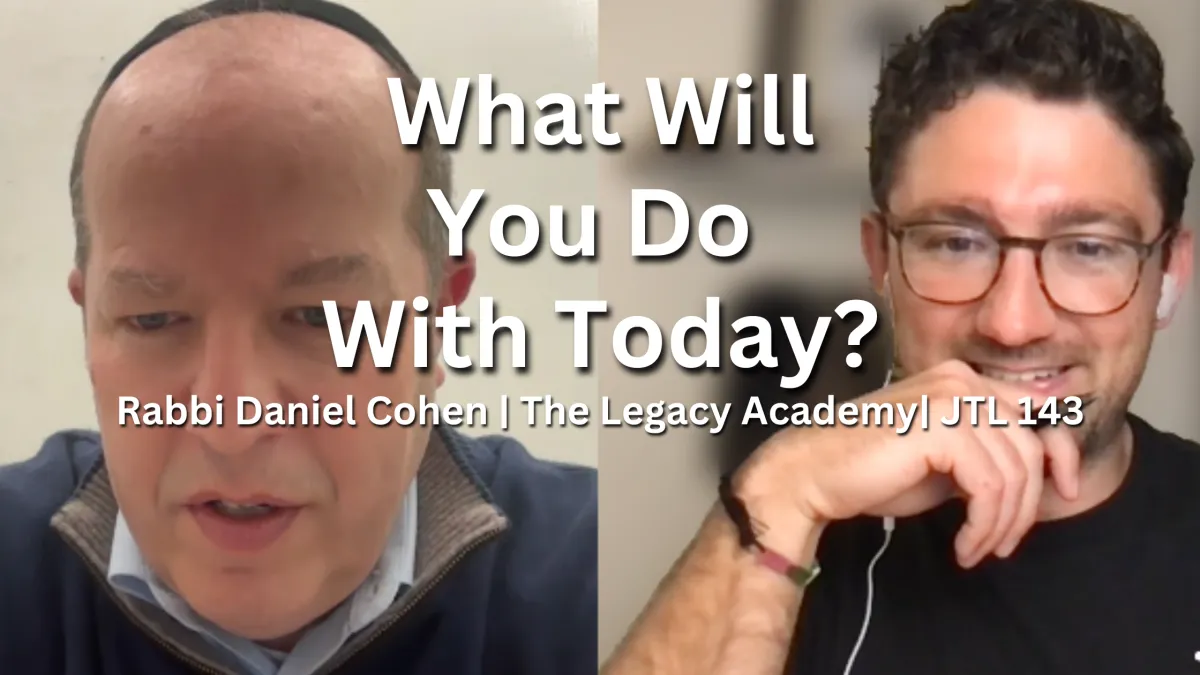
Rabbi Daniel Cohen | What Are You Doing With Today?
Want to hear the full conversation? Listen to the Journey To Legacy podcast Episode 143 with Rabbi Daniel Cohen for even more insights and stories from his remarkable entrepreneurial journey.
What Are You Doing With Today? | Rabbi Daniel Cohen on Legacy, Kindness & the Daily Diamond
Most people are not wasting their lives on purpose.
They are just busy.
Busy answering messages.
Busy solving problems.
Busy getting through the week.
Busy telling themselves they will slow down later.
And that is what made this conversation with Rabbi Daniel Cohen so powerful.
Because he put words to something most of us feel but rarely stop to acknowledge:
We are often moving so fast that we forget today is sacred.
Not in some vague poetic way.
In a very real way.
He shared a concept that has stayed with me ever since:
Every morning, God hands you an unpolished diamond.
And at the end of the day, you hand it back.
Suddenly a day is no longer just time to fill.
It is something priceless placed in your hands.
And the real question becomes:
What are you doing with it?
Legacy is not something for later
One of the things I appreciated most about this conversation is how Rabbi Cohen reframes the idea of legacy.
Most people associate legacy with the end of life.
With what people say about you after you're gone.
But Rabbi Cohen sees legacy very differently.
Legacy is not just something that happens after death.
Legacy is something you build every single day.
In the way you speak to people.
In the kindness you show.
In the gratitude you carry.
In the light you either spread or withhold.
That idea changes everything.
Because many people treat legacy like something far away.
Something to think about later.
Something for older versions of themselves.
But life rarely slows down enough for that.
There is always another email.
Another meeting.
Another problem.
Another distraction.
And before you know it, years have passed while you were simply trying to keep up.
The moment that changed everything
Rabbi Cohen shared a deeply personal part of his story.
His mother passed away suddenly from a brain aneurysm at just 44 years old.
When something like that happens, life stops being theoretical.
It becomes fragile.
Immediate.
Real.
He said that while he always valued life growing up, losing his mother changed the way he thought about time.
And then something even more profound happened.
Years later, he reached the same age his mother was when she died.
That moment forced a question most of us try to avoid:
Am I doing the most I can with the life God gave me?
It is not a comfortable question.
But it is an honest one.
Because once you start asking it seriously, you cannot keep drifting through life the same way.
Why thinking about death can wake you up to life
This might sound heavy, but the conversation was actually incredibly uplifting.
Rabbi Cohen explained that thinking about death is not meant to create fear.
It is meant to create clarity.
It is the reminder that time is limited.
That life is fragile.
That today matters.
He shared how people often leave funerals with a renewed focus on what truly matters in life.
For about fifteen minutes.
And then the rush of everyday life pulls them right back into autopilot.
The challenge is learning how to hold onto that clarity while we are still living.
The smallest moments matter more than we realize
One of the most powerful parts of the conversation was when Rabbi Cohen talked about everyday interactions.
A short elevator ride.
A quick hello.
A conversation in an Uber.
Ten seconds of kindness.
Most people overlook moments like that.
But what if those moments are the ones that matter most?
What if the smile you almost didn't give was exactly what someone needed?
What if a quick word of encouragement stayed with someone for years?
We rarely know what someone else is carrying.
And that is exactly why small acts of kindness matter so much.
Sometimes the smallest moment can change the direction of someone's entire day.
Or even their life.
Want to feel better? Help someone else
One of the most surprising ideas Rabbi Cohen shared was this:
If you are feeling down, one of the best things you can do is help someone else.
At first that sounds backwards.
When we are struggling, we instinctively turn inward.
But the truth is that healing often happens when we step outward.
By giving.
By encouraging.
By showing up for someone else.
Rabbi Cohen explained something simple but powerful:
Emotions often follow actions.
In other words, we do not always need to wait until we feel inspired.
Sometimes we act first.
Then the inspiration follows.
If you want to feel more gratitude, practice gratitude.
If you want to feel more kindness, practice kindness.
If you want more light in your life, bring light into someone else's.
Be the river, not the dam
One of my favorite lines from the conversation was this:
Don't be a dam. Be a river.
A dam collects and stores.
A river flows.
Rabbi Cohen's message is that life is not meant to be about collecting blessings only for ourselves.
It is about letting those blessings move through us.
We are meant to pass things forward.
To become conduits for light.
To bring encouragement where there is discouragement.
Hope where there is uncertainty.
Kindness where there is loneliness.
That is what living legacy actually looks like.
Five words that define a life
In his program, Rabbi Cohen asks people a powerful question:
What five words do you want people to remember about you?
Not your job title.
Not your income.
Not your hobbies.
But the impact you had on others.
He shared that someone once described his late mother with five unforgettable words:
"She was a stranger to no one."
What an incredible way to be remembered.
That single sentence paints a complete picture of who she was.
And it makes you ask a deeper question:
If someone described your life in five words, what would they say?
And more importantly:
What are you doing today to make those words true?
Stop lamenting the darkness
Rabbi Cohen shared a powerful piece of wisdom:
Don't lament the darkness. Increase the light.
It is easy to focus on everything that is wrong in the world.
The news.
The chaos.
The negativity.
But focusing on darkness does not remove it.
Light does.
Kindness does.
Gratitude does.
Encouragement does.
You may not be able to change the entire world.
But you can change someone's world.
Sometimes with something as simple as a conversation, a smile, or a moment of presence.
Living with intention
Rabbi Cohen has turned these ideas into a practical journey through his Legacy Academy, where people work through principles like gratitude, courage, purpose, and intentional living.
Through guided exercises, mentorship, and community discussions, participants learn how to build a life that reflects the legacy they want to leave behind.
You can learn more about the program and Rabbi Cohen's work here:
https://www.rabbidanielcohen.com/
So what will you do with today?
That is really the question this conversation leaves us with.
Not what you will do someday.
Not what people will say about you years from now.
But what you will do today.
The ordinary Tuesday.
The quiet conversation.
The unexpected interruption.
The person standing right in front of you.
Because legacy is rarely built in one big moment.
It is built in the small moments most people overlook.
And maybe that is the whole point of the diamond.
You are not handed a finished masterpiece.
You are handed potential.
And then you decide what to do with it.
Listen to the full episode on the Journey to Legacy Podcast to hear the full conversation with Rabbi Daniel Cohen about the daily diamond, kindness, gratitude, and building legacy one day at a time.
This blog post is based on Episode 143 of the Journey to Legacy podcast with host Wayne Veldsman.
At Journey To Legacy and the JTL Community, we focus on educational communications coaching to help you build stronger relationships and sell better. Join us and take your business and life to the next level, guaranteed.


